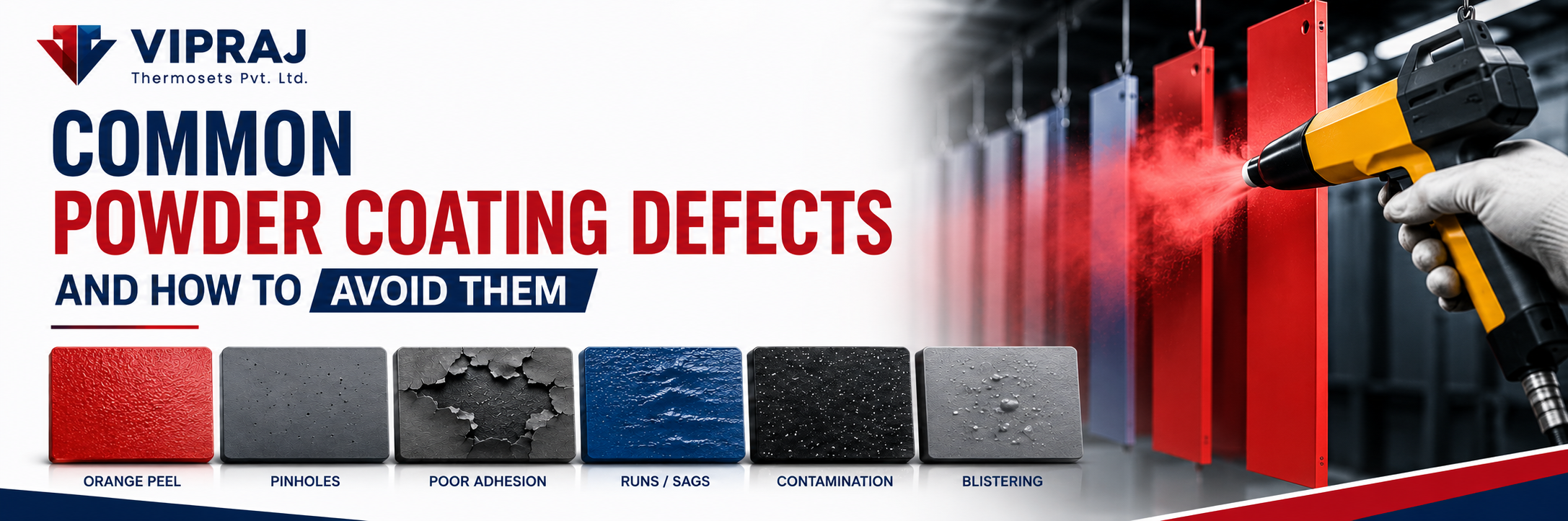
Common Powder Coating Defects and How to Avoid Them

Common Powder Coating Defects and How to Avoid Them

Common Powder Coating Defects and How to Avoid Them

Powder coating is widely used across industries because of its durability, smooth finish, corrosion resistance, and long-term performance. From electrical enclosures and furniture to automotive components and architectural structures, powder coating has become the preferred finishing solution for metal products.

However, even high-quality powder coatings can develop defects if the application process, surface preparation, or curing conditions are not properly controlled.

Understanding the most common powder coating defects and knowing how to prevent them can help manufacturers improve finish quality, reduce rejection rates, and increase customer satisfaction.

Why Powder Coating Defects Occur

Most powder coating problems happen because of:

  • Improper surface preparation
  • Contamination
  • Incorrect curing temperature
  • Poor grounding
  • Wrong film thickness
  • Environmental conditions during application

In many cases, small process mistakes can result in visible finish defects or coating failures.

Let’s look at the most common powder coating defects and how to avoid them.

Orange Peel Effect

What Is Orange Peel?

Orange peel is one of the most common powder coating defects where the coated surface develops a texture similar to the skin of an orange instead of a smooth finish.

Common Causes:

  • Improper curing temperature
  • Incorrect powder flow properties
  • Excessive film thickness
  • Poor spray gun settings
  • Inadequate grounding

How to Avoid It:

  • Maintain proper curing schedules
  • Ensure correct electrostatic settings
  • Apply recommended film thickness
  • Use high-quality powder coatings with good flow characteristics

Proper application control plays a major role in reducing orange peel in powder coating.

Pinholes and Air Bubbles

What Are Pinholes?

Pinholes are tiny holes or craters that appear on the coated surface after curing.

Common Causes:

  • Moisture or oil contamination
  • Trapped gases from porous metal surfaces
  • Improper pretreatment
  • Dirty compressed air

How to Avoid It:

  • Ensure proper cleaning and degreasing
  • Use dry, contamination-free compressed air
  • Preheat porous substrates if necessary
  • Maintain clean application equipment

Good surface preparation is essential for preventing pinholes in powder coating.

Poor Adhesion and Peeling

What Causes Poor Adhesion?

Poor adhesion occurs when the coating does not bond properly to the metal surface and starts peeling or flaking.

Common Causes:

  • Inadequate pretreatment
  • Oil, grease, or rust on the surface
  • Under-curing of powder coating
  • Improper phosphate treatment

How to Avoid It:

  • Use proper iron phosphate or zinc phosphate pretreatment
  • Completely remove rust, oil, and contaminants
  • Follow correct curing temperature and time
  • Check oven calibration regularly

Strong adhesion is critical for long-term powder coating performance.

Uneven Gloss or Color Variation

What Causes Shade Variation?

Inconsistent gloss or color difference is a common issue in high-volume production.

Common Causes:

  • Uneven curing temperature
  • Different batch usage
  • Poor powder storage conditions
  • Inconsistent film thickness

How to Avoid It:

  • Maintain stable curing conditions
  • Use powder from the same batch wherever possible
  • Store powder coatings in controlled conditions
  • Monitor film thickness using DFT meters

Consistent process control helps maintain color uniformity and gloss consistency.

Contact Us WhatsApp
Person using smartphone and laptop with colourful powder coating splash

Talk to Our Expert About Your Needs !

Find the Right Powder Coating for Your Application !

Explore Products